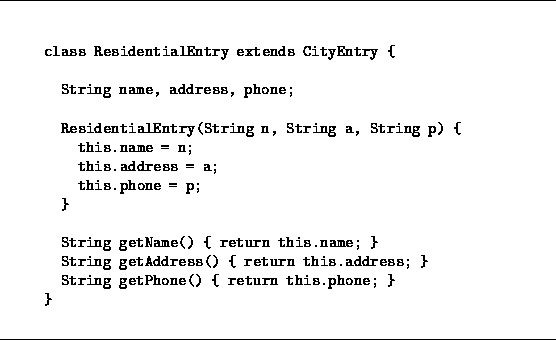
In our department directory example, an object of type Entry only has one form, namely an instance of class Entry. If we were designing the data for a more comprehensive directory such as a city phone directory, we would need more than one form of entry. At a minimum, we would need entry formats suitable for business listings, government listings, and residential listings. For such a phone directory, we might define an entry as follows.
A CityEntry is either:
The BusinessEntry and GovernmentEntry forms include city and state information because businesses and government agencies that serve clients in cities outside their local calling area often elect to have their phone numbers included in the directories of other cities (in addition to the cities where they are located). In addition, government listings include a string specifying the government entity to which they belong. For example, a listing for the Federal Bureau of Investigation would specify the "U.S. Government" as the gov field.
In Scheme, we could represent such an entry data type by defining three different structures:
Note that the type CityEntry consisting of the union of the types BusinessEntry, GovernmentEntry, and ResidentialEntry is not defined in program text because all union types in Scheme are implicit.;; a CityEntry is either: ;; a BusinessEntry ;; (make-BusinessEntry name addr phone city state), ;; or a GovernmentEntry ;; (make-GovernmentEntry name addr phone city state gov), ;; or a ResidentialEntry ;; (make-ResidentialEntry name addr phone). (define-struct BusinessEntry (name addr phone city state)) (define-struct GovernmentEntry (name addr phone city state gov)) (define-struct ResidentialEntry (name addr phone))
In Java, we can define the CityEntry type by introducing a
``dummy'' CityEntry class that we extend by ``concrete''
classes1.4 for each different form of Entry data. In
object oriented languages like Java, such ``dummy'' classes are called
abstract classes. This technique--using a ``dummy'' superclass
to group together related concrete classes--is called the union pattern.
It is very widely used on object-oriented programming. In
this pattern, an abstract class serves as the root of a hierarchy of
subclasses called variants, which are the component types of the
union. In this example, there are three variant classes: BusinessEntry, GovernmentEntry, ResidentialEntry. The
following Java code defines the city-entry type:
The Java code in the CityEntry example above involves several concepts that we have not discussed before.
The following expression creates a BusinessEntry for Rice University
new BusinessEntry("Rice University", "6100 Main Street",
                  "713-348-8101", "Houston", "Texas")
Finger Exercise Enter the preceding class definitions into the
definitions window of DrJava. Compile this program and evaluate the
following expressions in the interactions window:
BusinessEntry e1 =
  new BusinessEntry("Rice University", "6100 Main St.",
                    "713-527-8101", "Houston", "TX");
ResidentialEntry e2 =
  new ResidentialEntry("Robert Cartwright",
                       "3310 Underwood Street", "713-660-0967");
e1.getName()
e2.getName()