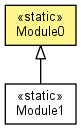
- java.lang.Object
-
- edu.rice.hj.Module0
-
- Direct Known Subclasses:
- Module1
public class Module0
extends Object
A facade to all the Habanero-Java operations like finish, async, forallNb, forasyncNb, finish-accumulators, phasers, abstract metrics, etc. The calls delegate to the actual HjRuntime instance.- Author:
- Shams Imam (shams@rice.edu)
-
-
Field Summary
Fields Modifier and Type Field and Description protected static AtomicBooleanruntimeInitializedConstantruntimeInitialized
-
Constructor Summary
Constructors Modifier Constructor and Description protectedModule0()Private constructor to disallow instance creation.
-
Method Summary
All Methods Static Methods Concrete Methods Modifier and Type Method and Description static HjMetricsabstractMetrics()Returns the metrics report for the currently executing task.static voidasyncNb(HjRunnable runnable)Creates a new asynchronous task to execute the wrapped statements.static voidasyncNbAt(HjPlace place, HjRunnable runnable)static <T> voidasyncNbAwait(HjFuture<T> f1, HjFuture<T> f2, HjFuture<T> f3, HjRunnable runnable)Construct to create an asynchronous task which is executed when all the futures are resolved.static <T> voidasyncNbAwait(HjFuture<T> f1, HjFuture<T> f2, HjRunnable runnable)Construct to create an asynchronous task which is executed when both the futures are resolved.static <T> voidasyncNbAwait(HjFuture<T> f1, HjRunnable runnable)Construct to create an asynchronous task which is executed when the futureNb is resolved.static <T> voidasyncNbAwait(List<HjFuture<T>> dependences, HjRunnable runnable)Construct to create an asynchronous task which is executed when all the futureNb are resolved.static voidasyncNbSeq(boolean sequentialize, HjRunnable runnable)Similar to the regularasyncNb(edu.rice.hj.api.HjRunnable)except that the boolean condition is used as a tuning parameter to determine if the async should just be executed sequentially (when the condition is true) in the parent task.static voidasyncNbSeq(boolean sequentialize, HjRunnable seqRunnable, HjRunnable parRunnable)Similar to the regularasyncNb(edu.rice.hj.api.HjRunnable)except that the boolean condition is used as a tuning parameter to determine if the async should just be executed sequentially (when the condition is true) in the parent task.static voidasyncPhased(HjPhaserPair phaserPair1, HjPhaserPair phaserPair2, HjSuspendable suspendable)Create an asynchronous task phased on a specified subset of its parent’s phasers with specified modes (e.g., phaser ph1 with mode1), or on the entire set of the parent's phasers and modes (by default, if no subset is specified).static voidasyncPhased(HjPhaserPair phaserPair, HjSuspendable suspendable)Create an asynchronous task phased on a specified subset of its parent’s phasers with specified modes (e.g., phaser ph1 with mode1), or on the entire set of the parent's phasers and modes (by default, if no subset is specified).static voidasyncPhased(List<HjPhaserPair> phaserList, HjSuspendable suspendable)Create an asynchronous task phased on a specified subset of its parent’s phasers with specified modes (e.g., phaser ph1 with mode1), or on the entire set of the parent's phasers and modes (by default, if no subset is specified).protected static intcomputeDefaultChunkSize(int startInc, int endInc)Computes the chunk size based on the number of iterations and the number of worker threads.static voiddoWait()wait on each phaser that task is registered on with a wait capability (WAIT, SIG_WAIT). wait is a potentially blocking operation.static voiddoWork(long n)Used by abstract performance metrics to report work done by the currently executing task.static voiddumpEventLog(PrintStream printStream)Dumps the events tracked by the runtime.static voidemergencyShutdown(Throwable cause)Immediately exit the program due to an execution error.static voidfinalizeHabanero()Cleans up all Habanero-Java state.static voidfinish(HjFinishAccumulator f1, HjFinishAccumulator f2, HjFinishAccumulator f3, HjSuspendable suspendable)finish.static voidfinish(HjFinishAccumulator f1, HjFinishAccumulator f2, HjSuspendable suspendable)finish.static voidfinish(HjFinishAccumulator f1, HjSuspendable suspendable)finish.static voidfinish(HjSuspendable suspendable)Creates a new finish scope to execute the wrapped statements.static voidfinish(List<HjFinishAccumulator> accumulators, HjSuspendable suspendable)finish.static voidforallNb(HjRegion.HjRegion1D hjRegion, HjProcedureInt1D body)Construct to represent loop-level parallelism.static voidforallNb(HjRegion.HjRegion2D hjRegion, HjProcedureInt2D body)Construct to represent loop-level parallelism.static voidforallNb(HjRegion.HjRegion3D hjRegion, HjProcedureInt3D body)Construct to represent loop-level parallelism.static voidforallNb(int startInc, int endInc, HjProcedure<Integer> body)Construct to represent loop-level parallelism.static voidforallNb(int s0, int e0, int s1, int e1, HjProcedureInt2D body)Construct to represent loop-level parallelism.static <T> voidforallNb(Iterable<T> iterable, HjProcedure<T> body)Construct to represent loop-level parallelism.static voidforallNbChunked(HjRegion.HjRegion1D hjRegion, HjProcedureInt1D body)Construct to represent loop-level parallelism using chunking/grouping.static voidforallNbChunked(HjRegion.HjRegion2D hjRegion, HjProcedureInt2D body)Construct to represent loop-level parallelism using chunking/grouping.static voidforallNbChunked(HjRegion.HjRegion3D hjRegion, HjProcedureInt3D body)Construct to represent loop-level parallelism using chunking/grouping.static voidforallNbChunked(int startInc, int endInc, HjProcedure<Integer> body)Construct to represent loop-level parallelism using chunking/grouping.static voidforallNbChunked(int startInc, int endInc, int chunkSize, HjProcedure<Integer> body)Construct to represent loop-level parallelism using chunking/grouping.static voidforallNbChunked(int s0, int e0, int s1, int e1, HjProcedureInt2D body)Construct to represent loop-level parallelism using chunking/grouping.static voidforallPhased(int startInc, int endInc, HjSuspendingProcedure<Integer> body)In forallPhased, you have a phaser registered with the spawned asyncs (there is one async for each iteration of the loop) implicitly.static <T> voidforallPhased(Iterable<T> iterable, HjSuspendingProcedure<T> body)In forallPhased, you have a phaser registered with the spawned asyncs (there is one async for each iteration of the loop) implicitly.static voidforasync(HjRegion.HjRegion1D hjRegion, HjProcedureInt1D body)Construct to represent loop-level parallelism.static voidforasyncChunked(HjRegion.HjRegion1D hjRegion, HjProcedureInt1D body)Construct to represent loop-level parallelism.static voidforasyncNb(HjRegion.HjRegion2D hjRegion, HjProcedureInt2D body)Construct to represent loop-level parallelism.static voidforasyncNb(HjRegion.HjRegion3D hjRegion, HjProcedureInt3D body)Construct to represent loop-level parallelism.static voidforasyncNb(int startInc, int endInc, HjProcedure<Integer> body)Construct to represent loop-level parallelism.static voidforasyncNb(int s0, int e0, int s1, int e1, HjProcedureInt2D body)Construct to represent loop-level parallelism.static <T> voidforasyncNb(Iterable<T> iterable, HjProcedure<T> body)Construct to represent loop-level parallelism.static voidforasyncNbChunked(HjRegion.HjRegion2D hjRegion, HjProcedureInt2D body)Construct to represent loop-level parallelism.static voidforasyncNbChunked(HjRegion.HjRegion3D hjRegion, HjProcedureInt3D body)Construct to represent loop-level parallelism.static voidforasyncNbChunked(int startInc, int endInc, HjProcedure<Integer> body)Construct to represent loop-level parallelism.static voidforasyncNbChunked(int startInc, int endInc, int chunkSize, HjProcedure<Integer> body)Construct to represent loop-level parallelism.static voidforasyncPhased(int startInc, int endInc, HjSuspendingProcedure<Integer> body)In forasyncPhased, you have a phaser registered with the spawned asyncs (there is one async for each iteration of the loop) implicitly.static voidforasyncPhased(int startInc, int endInc, List<HjPhaserPair> phaserList, HjSuspendingProcedure<Integer> body)In this variant of forasyncPhased, you have phasers registered with the spawned asyncs (there is one async for each iteration of the loop) explicitly.static <T> voidforasyncPhased(Iterable<T> iterable, List<HjPhaserPair> phaserList, HjSuspendingProcedure<T> body)In this variant of forasyncPhased, you have phasers registered with the spawned asyncs (there is one async for each iteration of the loop) explicitly.static voidforseqNb(HjRegion.HjRegion1D hjRegion, HjProcedureInt1D body)Construct to represent a sequential loop while working with regions.static voidforseqNb(HjRegion.HjRegion2D hjRegion, HjProcedureInt2D body)Construct to represent a sequential loop while working with regions.static voidforseqNb(HjRegion.HjRegion3D hjRegion, HjProcedureInt3D body)Construct to represent a sequential loop while working with regions.static voidforseqNb(int startInc, int endInc, HjProcedure<Integer> body)Construct to represent loop-level parallelism.static voidforseqNb(int s0, int e0, int s1, int e1, HjProcedureInt2D body)Construct to represent loop-level parallelism.static <T> voidforseqNb(Iterable<T> iterable, HjProcedure<T> body)Construct to represent loop-level parallelism.static <V> HjFuture<V>futureNb(HjCallable<V> callable)Construct to create an asynchronous task that returns a result which will be available in the futureNb.static <T,V> HjFuture<V>futureNbAwait(HjFuture<T> f1, HjCallable<V> callable)futureNbAwait.static <T,V> HjFuture<V>futureNbAwait(HjFuture<T> f1, HjFuture<T> f2, HjCallable<V> callable)futureNbAwait.static <T,V> HjFuture<V>futureNbAwait(HjFuture<T> f1, HjFuture<T> f2, HjFuture<T> f3, HjCallable<V> callable)futureNbAwait.static <T,V> HjFuture<V>futureNbAwait(List<HjFuture<T>> dependences, HjCallable<V> callable)futureNbAwait.static <V> HjFuture<V>futureNbSeq(boolean sequentialize, HjCallable<V> callable)Construct to create an asynchronous task that returns a result which will be available in the future.static <V> HjFuture<V>futureNbSeq(boolean sequentialize, HjCallable<V> seqCallable, HjCallable<V> parCallable)Similar to the regularfutureNb(edu.rice.hj.api.HjCallable)except that the boolean condition is used as a tuning parameter to determine if the future should just be executed sequentially (when the condition is true) in the parent task.static List<HjRegion.HjRegion1D>group(HjRegion.HjRegion1D hjRegion, int processorGrid)Evenly divides the loop iteration space intoprocessorGridchunks.static List<HjRegion.HjRegion2D>group(HjRegion.HjRegion2D hjRegion, int processorGrid0, int processorGrid1)Evenly divides the loop iteration space intoprocessorGrid0 x processorGrid1chunks.static HjPlacehere()static voidinitializeHabanero()Initialize the Habanero-Java execution environment.static voidlaunchHabaneroApp(HjSuspendable suspendable)Launches the fragment of code to be run by the habanero runtime.static voidlaunchHabaneroApp(HjSuspendable suspendable, Runnable preFinalizeCallback)Launches the fragment of code to be run by the habanero runtime.static HjRegion.HjRegion1DmyGroup(int groupId, HjRegion.HjRegion1D hjRegion, int groupSize)Retrieves the region represented for the givengroupIdwhen the iteration space is divided intogroupSizegroups.static RectangularRegion2DmyGroup(int groupId0, int groupId1, HjRegion.HjRegion2D hjRegion, int groupSize0, int groupSize1)Retrieves the region represented for the given(groupId0, groupId1)when the iteration space is divided intogroupSize0 x groupSize1groups.static <V> HjDataDrivenFuture<V>newDataDrivenFuture()Factory method to create a DataDrivenFuture instance.static <V> HjDataDrivenFuture<V>newDataDrivenFuture(boolean allowDuplicatePuts)Factory method to create a DataDrivenFuture instance.static <V> HjDataDrivenFuture<V>newDDF()Factory method to create a DataDrivenFuture instance.static <V> HjDataDrivenFuture<V>newDDF(boolean allowDuplicates)Factory method to create a DataDrivenFuture instance.static HjFinishAccumulatornewFinishAccumulator(HjOperator ope, Class type)Factory method to create a HjFinishAccumulator object.static HjPhasernewPhaser(HjPhaserMode phaserMode)Factory method to create a newHjPhaserwith the specified mode.static HjPhasernewPhaser(HjPhaserMode phaserMode, int busyWaitLimit)Factory method to create a newHjPhaserwith the specified mode.static HjPointnewPoint(int... values)Factory method to create new HjPoint instances.static HjRegion.HjRegion1DnewRectangularRegion1D(int pMinInc, int pMaxInc)Factory method to create a 1D rectangular region object.static HjRegion.HjRegion2DnewRectangularRegion2D(int pMinInc0, int pMaxInc0, int pMinInc1, int pMaxInc1)Factory method to create a 2D rectangular region object.static HjRegion.HjRegion3DnewRectangularRegion3D(int pMinInc0, int pMaxInc0, int pMinInc1, int pMaxInc1, int pMinInc2, int pMaxInc2)Factory method to create a 3D rectangular region object.static voidnext()Advance each phaser that this task is registered on to its next phase, in accordance with this task's registration mode.static intnumPlaces()static intnumWorkerThreads()Return the number of worker threads employed by the runtime.static HjPlaceplace(int id)static voidprintBuildInfo(PrintStream outputStream)Prints the String representing of the build information.static voidsignal()signal each phaser that task is registered on with a signal capability (SIG, SIG_WAIT, SIGNAL). signal is a non-blocking operation - computation between signal and next serves as a 'split phase barrier'static boolean[]waitAll(HjFuture[] futures)Blocks until all of the operations associated with the active requests in the array have completed.static boolean[]waitAny(HjFuture[] futures)Blocks until one of the operations associated with the active requests in the array has completed successfully.
-
-
-
Field Detail
-
runtimeInitialized
protected static AtomicBoolean runtimeInitialized
ConstantruntimeInitialized
-
-
Method Detail
-
printBuildInfo
public static void printBuildInfo(PrintStream outputStream)
Prints the String representing of the build information.
-
launchHabaneroApp
public static void launchHabaneroApp(HjSuspendable suspendable)
Launches the fragment of code to be run by the habanero runtime.
-
launchHabaneroApp
public static void launchHabaneroApp(HjSuspendable suspendable,
                                     Runnable preFinalizeCallback)
Launches the fragment of code to be run by the habanero runtime.
-
finish
public static void finish(HjSuspendable suspendable)
                   throws SuspendableException
Creates a new finish scope to execute the wrapped statements.Usage:
ORfinish(() -> S1);finish(() -> {S1; S2;...});Execute statements S1, S2, ..., but wait until all (transitively) spawned asyncs and futures enclosed in the statements scope have terminated. Also, propagate a list of all exceptions thrown by asyncs spawned within statements's scope.
- Parameters:
suspendable- aHjSuspendableobject.- Throws:
SuspendableException- See Also:
HjRuntime.finish(edu.rice.hj.api.HjSuspendable)
-
initializeHabanero
public static void initializeHabanero()
Initialize the Habanero-Java execution environment.
-
finalizeHabanero
public static void finalizeHabanero()
Cleans up all Habanero-Java state.
-
emergencyShutdown
public static void emergencyShutdown(Throwable cause)
Immediately exit the program due to an execution error.- Parameters:
cause- aThrowableobject.- See Also:
HjRuntime.emergencyShutdown(Throwable)
-
numWorkerThreads
public static int numWorkerThreads()
Return the number of worker threads employed by the runtime. Usage:final int numThreads = numWorkerThreads();- Returns:
- the number of worker threads employed by the runtime.
- See Also:
HjRuntime.numWorkerThreads()
-
asyncNb
public static void asyncNb(HjRunnable runnable)
Creates a new asynchronous task to execute the wrapped statements.Usage:
ORHjRunnable aRunnable = () -> { S1; }; async(aRunnable);
ORasync(() -> S1);async(() -> {S1; S2;...});Spawn a new child task to execute statements S1, S2, ... asynchronously (i.e., before, after, or in parallel) with the remainder of the parent task.
In general, an HJ program can create an unbounded number of tasks at runtime.
The HJ runtime system is responsible for scheduling these tasks on a fixed number of processors.- Parameters:
runnable- aHjRunnableobject.- See Also:
HjRuntime.asyncSeqAt(boolean, edu.rice.hj.api.HjPlace, edu.rice.hj.api.HjRunnable)
-
asyncNbSeq
public static void asyncNbSeq(boolean sequentialize,
                              HjRunnable runnable)
Similar to the regularasyncNb(edu.rice.hj.api.HjRunnable)except that the boolean condition is used as a tuning parameter to determine if the async should just be executed sequentially (when the condition is true) in the parent task.
The semantics of
are as follows:asyncNbSeq(cond, () -> S1)if (cond) S1; else async(() -> S1);- Parameters:
sequentialize- a boolean.runnable- aHjRunnableobject.- See Also:
HjRuntime.asyncSeqAt(boolean, edu.rice.hj.api.HjPlace, edu.rice.hj.api.HjRunnable)
-
asyncNbSeq
public static void asyncNbSeq(boolean sequentialize,
                              HjRunnable seqRunnable,
                              HjRunnable parRunnable)
Similar to the regularasyncNb(edu.rice.hj.api.HjRunnable)except that the boolean condition is used as a tuning parameter to determine if the async should just be executed sequentially (when the condition is true) in the parent task.
The semantics of
are as follows:asyncNbSeq(cond, () -> S1, () -> S2)if (cond) S1; else async(() -> S2);- Parameters:
sequentialize- The flag that determines whether the runtime should consider running the body asynchronously.seqRunnable- The body of the code to run when sequentialize flag is true.parRunnable- The body of the code to run when sequentialize flag is false.- See Also:
HjRuntime.asyncSeqAt(boolean, edu.rice.hj.api.HjPlace, edu.rice.hj.api.HjRunnable)
-
forseqNb
public static <T> void forseqNb(Iterable<T> iterable,
                                HjProcedure<T> body)
Construct to represent loop-level parallelism. An implicit finish is included for all iterations of the forallNb.The semantics of
are as follows:forseqNb(iterableOfT, (k) -> S2(k))for (T k : iterableOfT) { S2(k); }- Parameters:
iterable- aIterableobject.body- aHjProcedureobject.
-
forallNb
public static <T> void forallNb(Iterable<T> iterable,
                                HjProcedure<T> body)
                         throws SuspendableException
Construct to represent loop-level parallelism. An implicit finish is included for all iterations of the forallNb.The semantics of
are as follows:forallNb(iterableOfT, (k) -> S2(k))finish(() -> { for (T k : iterableOfT) { final T kk = k; async(() -> { S2(kk); }); } });- Type Parameters:
T- a T object.- Parameters:
iterable- aIterableobject.body- aHjProcedureobject.- Throws:
SuspendableException- See Also:
forasyncNb(Iterable, edu.rice.hj.api.HjProcedure)
-
forasyncNb
public static <T> void forasyncNb(Iterable<T> iterable,
                                  HjProcedure<T> body)
Construct to represent loop-level parallelism. There is no implicit finish in the iterations of forasyncNb.The semantics of
are as follows:forasyncNb(iterableOfT, (k) -> S2(k))for (T k : iterableOfT) { final T kk = k; async(() -> { S2(kk); }); }- Type Parameters:
T- a T object.- Parameters:
iterable- aIterableobject.body- aHjProcedureobject.
-
forseqNb
public static void forseqNb(int startInc,
                            int endInc,
                            HjProcedure<Integer> body)
Construct to represent loop-level parallelism. An implicit finish is included for all iterations of the forallNb.The semantics of
are as follows:forseqNb(startInc, endInc, (k) -> S2(k))for (int k = startInc; k <= endInc; k++) { S2(k); }- Parameters:
startInc- a int.endInc- a int.body- aHjProcedureobject.- See Also:
forasyncNb(int, int, edu.rice.hj.api.HjProcedure)
-
newRectangularRegion1D
public static HjRegion.HjRegion1D newRectangularRegion1D(int pMinInc,
                                                         int pMaxInc)
Factory method to create a 1D rectangular region object.- Parameters:
pMinInc- a int.pMaxInc- a int.- Returns:
- a
HjRegion.HjRegion1Dobject. - See Also:
RegionFactory.newRectangularRegion1D(int, int)
-
forallNb
public static void forallNb(int startInc,
                            int endInc,
                            HjProcedure<Integer> body)
                     throws SuspendableException
Construct to represent loop-level parallelism. An implicit finish is included for all iterations of the forallNb.The semantics of
are as follows:forallNb(startInc, endInc, (k) -> S2(k))finish(() -> { for (int k = startInc; k <= endInc; k++) { final int kk = k; async(() -> { S2(kk); }); } });- Parameters:
startInc- a int.endInc- a int.body- aHjProcedureobject.- Throws:
SuspendableException- See Also:
forasyncNb(int, int, edu.rice.hj.api.HjProcedure)
-
forasyncNb
public static void forasyncNb(int startInc,
                              int endInc,
                              HjProcedure<Integer> body)
Construct to represent loop-level parallelism. There is no implicit finish in the iterations of forasyncNb.The semantics of
are as follows:forasyncNb(startInc, endInc, (k) -> S2(k))for (int k = startInc; k <= endInc; k++) { final int kk = k; async(() -> { S2(kk); }); }- Parameters:
startInc- a int.endInc- a int.body- aHjProcedureobject.
-
forallNbChunked
public static void forallNbChunked(int startInc,
                                   int endInc,
                                   HjProcedure<Integer> body)
                            throws SuspendableException
Construct to represent loop-level parallelism using chunking/grouping. An implicit finish is included for all iterations of the forallNb.The HJ runtime ensures that it does not create more tasks than the number of available worker threads for the loop.
refer to
forallNb(int, int, edu.rice.hj.api.HjProcedure),forallNbChunked(int, int, int, edu.rice.hj.api.HjProcedure), andforasyncNbChunked(int, int, int, edu.rice.hj.api.HjProcedure)- Parameters:
startInc- a int.endInc- a int.body- aHjProcedureobject.- Throws:
SuspendableException
-
computeDefaultChunkSize
protected static int computeDefaultChunkSize(int startInc,
                                             int endInc)
Computes the chunk size based on the number of iterations and the number of worker threads.- Returns:
- the chunk size
-
forallNbChunked
public static void forallNbChunked(int startInc,
                                   int endInc,
                                   int chunkSize,
                                   HjProcedure<Integer> body)
                            throws SuspendableException
Construct to represent loop-level parallelism using chunking/grouping. An implicit finish is included for all iterations of the forallNb.In this variant, the user has control over the chunk size used and hence the number of tasks created for the loop.
refer to
forallNb(int, int, edu.rice.hj.api.HjProcedure)andforasyncNbChunked(int, int, int, edu.rice.hj.api.HjProcedure)- Parameters:
startInc- a int.endInc- a int.chunkSize- a int.body- aHjProcedureobject.- Throws:
SuspendableException
-
forasyncNbChunked
public static void forasyncNbChunked(int startInc,
                                     int endInc,
                                     int chunkSize,
                                     HjProcedure<Integer> body)
Construct to represent loop-level parallelism. There is no implicit finish in the iterations of forasyncNb.In this variant, the user has control over the chunk size used and hence the number of tasks created for the loop.
- Parameters:
startInc- a int.endInc- a int.chunkSize- a int.body- aHjProcedureobject.
-
forasyncNbChunked
public static void forasyncNbChunked(int startInc,
                                     int endInc,
                                     HjProcedure<Integer> body)
Construct to represent loop-level parallelism. There is no implicit finish in the iterations of forasyncNb.The HJ runtime ensures that it does not create more tasks than the number of available worker threads for the loop.
- Parameters:
startInc- a int.endInc- a int.body- aHjProcedureobject.- See Also:
forasyncNbChunked(int, int, int, edu.rice.hj.api.HjProcedure)
-
futureNb
public static <V> HjFuture<V> futureNb(HjCallable<V> callable)
Construct to create an asynchronous task that returns a result which will be available in the futureNb. Usage:
ORHjCallableaCallable = () -> { return S1; }; HjFuture aFuture = futureNb(aRunnable); HjFutureaFuture = futureNb(() -> { return S1; }); Support for async tasks with return values.
aFuturecontains a "futureNb handle" to the newly created task and the operationaFuture.get()(also known as a force operation) can be performed to obtain the result of the futureNb task.
The futureNb task executes statement S1 asynchronously (i.e., before, after, or in parallel) with the remainder of the parent task.
In general, an HJ program can create an unbounded number of futures at runtime.
The HJ runtime system is responsible for scheduling these futureNb tasks on a fixed number of processors.- Type Parameters:
V- a V object.- Parameters:
callable- aHjCallableobject.- Returns:
- a
HjFutureobject. - See Also:
HjRuntime.futureSeq(boolean, edu.rice.hj.api.HjCallable)
-
futureNbSeq
public static <V> HjFuture<V> futureNbSeq(boolean sequentialize,
                                          HjCallable<V> callable)
Construct to create an asynchronous task that returns a result which will be available in the future. Similar to the regularfutureNb(edu.rice.hj.api.HjCallable)except that the boolean condition is used as a tuning parameter to determine if the future should just be executed sequentially (when the condition is true) in the parent task.
SeeasyncNbSeq(boolean, edu.rice.hj.api.HjRunnable)- Type Parameters:
V- a V object.- Parameters:
sequentialize- a boolean.callable- aHjCallableobject.- Returns:
- a
HjFutureobject. - See Also:
HjRuntime.futureSeq(boolean, edu.rice.hj.api.HjCallable)
-
futureNbSeq
public static <V> HjFuture<V> futureNbSeq(boolean sequentialize,
                                          HjCallable<V> seqCallable,
                                          HjCallable<V> parCallable)
Similar to the regularfutureNb(edu.rice.hj.api.HjCallable)except that the boolean condition is used as a tuning parameter to determine if the future should just be executed sequentially (when the condition is true) in the parent task.
SeeasyncNbSeq(boolean, edu.rice.hj.api.HjRunnable, edu.rice.hj.api.HjRunnable)- Type Parameters:
V- a V object.- Parameters:
sequentialize- The flag that determines whether the runtime should consider running the body asynchronously.seqCallable- The body of the code to run when sequentialize flag is true.parCallable- The body of the code to run when sequentialize flag is false.- Returns:
- a
HjFutureobject. - See Also:
HjRuntime.futureSeq(boolean, edu.rice.hj.api.HjCallable)
-
newDDF
public static <V> HjDataDrivenFuture<V> newDDF()
Factory method to create a DataDrivenFuture instance.- Type Parameters:
V- a V object.- Returns:
- a
HjDataDrivenFutureobject. - See Also:
HjRuntime.newDataDrivenFuture(boolean)
-
newDDF
public static <V> HjDataDrivenFuture<V> newDDF(boolean allowDuplicates)
Factory method to create a DataDrivenFuture instance.- Type Parameters:
V- a V object.- Returns:
- a
HjDataDrivenFutureobject. - See Also:
HjRuntime.newDataDrivenFuture(boolean)
-
newDataDrivenFuture
public static <V> HjDataDrivenFuture<V> newDataDrivenFuture()
Factory method to create a DataDrivenFuture instance.- Type Parameters:
V- a V object.- Returns:
- a
HjDataDrivenFutureobject. - See Also:
HjRuntime.newDataDrivenFuture(boolean)
-
newDataDrivenFuture
public static <V> HjDataDrivenFuture<V> newDataDrivenFuture(boolean allowDuplicatePuts)
Factory method to create a DataDrivenFuture instance.- Type Parameters:
V- a V object.- Returns:
- a
HjDataDrivenFutureobject. - See Also:
HjRuntime.newDataDrivenFuture(boolean)
-
asyncNbAwait
public static <T> void asyncNbAwait(HjFuture<T> f1,
                                    HjRunnable runnable)
Construct to create an asynchronous task which is executed when the futureNb is resolved.- Parameters:
f1- The futureNb (or DDF) on which to register the callbackrunnable- The callback to execute asynchronously when the futureNb (or DDF) is resolved- See Also:
HjRuntime.asyncAwait(java.util.List, edu.rice.hj.api.HjRunnable)
-
asyncNbAwait
public static <T> void asyncNbAwait(List<HjFuture<T>> dependences,
                                    HjRunnable runnable)
Construct to create an asynchronous task which is executed when all the futureNb are resolved.- Parameters:
dependences- aListobject.runnable- aHjRunnableobject.- See Also:
HjRuntime.asyncAwait(java.util.List, edu.rice.hj.api.HjRunnable)
-
asyncNbAwait
public static <T> void asyncNbAwait(HjFuture<T> f1,
                                    HjFuture<T> f2,
                                    HjRunnable runnable)
Construct to create an asynchronous task which is executed when both the futures are resolved.- Parameters:
f1- The futureNb (or DDF) on which to register the callbackf2- The futureNb (or DDF) on which to register the callbackrunnable- The callback to execute asynchronously when the both futures (or DDFs) are resolved- See Also:
HjRuntime.asyncAwait(java.util.List, edu.rice.hj.api.HjRunnable)
-
asyncNbAwait
public static <T> void asyncNbAwait(HjFuture<T> f1,
                                    HjFuture<T> f2,
                                    HjFuture<T> f3,
                                    HjRunnable runnable)
Construct to create an asynchronous task which is executed when all the futures are resolved.- Parameters:
f1- The futureNb (or DDF) on which to register the callbackf2- The futureNb (or DDF) on which to register the callbackf3- The futureNb (or DDF) on which to register the callbackrunnable- The callback to execute asynchronously when the all futures (or DDFs) are resolved- See Also:
HjRuntime.asyncAwait(java.util.List, edu.rice.hj.api.HjRunnable)
-
futureNbAwait
public static <T,V> HjFuture<V> futureNbAwait(HjFuture<T> f1,
                                              HjCallable<V> callable)
futureNbAwait.
- Type Parameters:
V- a V object.- Parameters:
f1- aHjFutureobject.callable- aHjCallableobject.- Returns:
- a
HjFutureobject. - See Also:
HjRuntime.futureAwait(java.util.List, edu.rice.hj.api.HjCallable)
-
futureNbAwait
public static <T,V> HjFuture<V> futureNbAwait(List<HjFuture<T>> dependences,
                                              HjCallable<V> callable)
futureNbAwait.
- Type Parameters:
V- a V object.- Parameters:
dependences- aListobject.callable- aHjCallableobject.- Returns:
- a
HjFutureobject. - See Also:
HjRuntime.futureAwait(java.util.List, edu.rice.hj.api.HjCallable)
-
futureNbAwait
public static <T,V> HjFuture<V> futureNbAwait(HjFuture<T> f1,
                                              HjFuture<T> f2,
                                              HjCallable<V> callable)
futureNbAwait.
- Type Parameters:
V- a V object.- Parameters:
f1- aHjFutureobject.f2- aHjFutureobject.callable- aHjCallableobject.- Returns:
- a
HjFutureobject. - See Also:
HjRuntime.futureAwait(java.util.List, edu.rice.hj.api.HjCallable)
-
futureNbAwait
public static <T,V> HjFuture<V> futureNbAwait(HjFuture<T> f1,
                                              HjFuture<T> f2,
                                              HjFuture<T> f3,
                                              HjCallable<V> callable)
futureNbAwait.
- Type Parameters:
V- a V object.- Parameters:
f1- aHjFutureobject.f2- aHjFutureobject.f3- aHjFutureobject.callable- aHjCallableobject.- Returns:
- a
HjFutureobject. - See Also:
HjRuntime.futureAwait(java.util.List, edu.rice.hj.api.HjCallable)
-
waitAll
public static boolean[] waitAll(HjFuture[] futures)
                         throws SuspendableException
Blocks until all of the operations associated with the active requests in the array have completed.waitAll()is a like a finish scope for all requests in the array. NOTE: This operation blocks the worker thread!- Parameters:
futures- The input futureNb array, we need to wait on all of them.- Returns:
- boolean array of statuses (true = completed successfully, false = there was an error in computing the result of the futureNb).
- Throws:
SuspendableException
-
waitAny
public static boolean[] waitAny(HjFuture[] futures)
Blocks until one of the operations associated with the active requests in the array has completed successfully. NOTE: This operation blocks the worker thread as there is a busy loop trying to match a successful futureNb!- Parameters:
futures- The input futureNb array, we need to wait on only one of them.- Returns:
- boolean array of statuses (true = completed successfully, false = there was an error in computing the result of the futureNb).
-
newFinishAccumulator
public static HjFinishAccumulator newFinishAccumulator(HjOperator ope,
                                                       Class type)
Factory method to create a HjFinishAccumulator object.- Parameters:
ope- aHjOperatorobject.type- aClassobject.- Returns:
- a
HjFinishAccumulatorobject. - See Also:
HjRuntime.newFinishAccumulator(edu.rice.hj.api.HjOperator, Class)
-
finish
public static void finish(HjFinishAccumulator f1,
                          HjSuspendable suspendable)
                   throws SuspendableException
finish.
- Parameters:
f1- aHjFinishAccumulatorobject.suspendable- aHjSuspendableobject.- Throws:
SuspendableException- See Also:
HjRuntime.finish(java.util.List, edu.rice.hj.api.HjSuspendable)
-
finish
public static void finish(List<HjFinishAccumulator> accumulators,
                          HjSuspendable suspendable)
                   throws SuspendableException
finish.
- Parameters:
accumulators- aListobject.suspendable- aHjSuspendableobject.- Throws:
SuspendableException- See Also:
HjRuntime.finish(java.util.List, edu.rice.hj.api.HjSuspendable)
-
finish
public static void finish(HjFinishAccumulator f1,
                          HjFinishAccumulator f2,
                          HjSuspendable suspendable)
                   throws SuspendableException
finish.
- Parameters:
f1- aHjFinishAccumulatorobject.f2- aHjFinishAccumulatorobject.suspendable- aHjSuspendableobject.- Throws:
SuspendableException- See Also:
HjRuntime.finish(java.util.List, edu.rice.hj.api.HjSuspendable)
-
finish
public static void finish(HjFinishAccumulator f1,
                          HjFinishAccumulator f2,
                          HjFinishAccumulator f3,
                          HjSuspendable suspendable)
                   throws SuspendableException
finish.
- Parameters:
f1- aHjFinishAccumulatorobject.f2- aHjFinishAccumulatorobject.f3- aHjFinishAccumulatorobject.suspendable- aHjSuspendableobject.- Throws:
SuspendableException- See Also:
HjRuntime.finish(java.util.List, edu.rice.hj.api.HjSuspendable)
-
asyncPhased
public static void asyncPhased(HjPhaserPair phaserPair,
                               HjSuspendable suspendable)
Create an asynchronous task phased on a specified subset of its parent’s phasers with specified modes (e.g., phaser ph1 with mode1), or on the entire set of the parent's phasers and modes (by default, if no subset is specified).- Parameters:
phaserPair- aHjPhaserPairobject.suspendable- aHjSuspendableobject.- See Also:
HjRuntime.asyncPhased(java.util.List, edu.rice.hj.api.HjSuspendable)
-
asyncPhased
public static void asyncPhased(HjPhaserPair phaserPair1,
                               HjPhaserPair phaserPair2,
                               HjSuspendable suspendable)
Create an asynchronous task phased on a specified subset of its parent’s phasers with specified modes (e.g., phaser ph1 with mode1), or on the entire set of the parent's phasers and modes (by default, if no subset is specified).- Parameters:
phaserPair1- aHjPhaserPairobject.phaserPair2- aHjPhaserPairobject.suspendable- aHjSuspendableobject.- See Also:
HjRuntime.asyncPhased(java.util.List, edu.rice.hj.api.HjSuspendable)
-
asyncPhased
public static void asyncPhased(List<HjPhaserPair> phaserList,
                               HjSuspendable suspendable)
Create an asynchronous task phased on a specified subset of its parent’s phasers with specified modes (e.g., phaser ph1 with mode1), or on the entire set of the parent's phasers and modes (by default, if no subset is specified).- Parameters:
phaserList- aListobject.suspendable- aHjSuspendableobject.- See Also:
HjRuntime.asyncPhased(java.util.List, edu.rice.hj.api.HjSuspendable)
-
forallPhased
public static void forallPhased(int startInc,
                                int endInc,
                                HjSuspendingProcedure<Integer> body)
                         throws SuspendableException
In forallPhased, you have a phaser registered with the spawned asyncs (there is one async for each iteration of the loop) implicitly.Example usage:
Here, all the hellos appear before all the goodbyes.forallPhased(0, m - 1, (i) -> { System.out.println("Hello " + i); next(); // Barrier System.out.println("Goodbye " + i); });Please refer to
forasyncPhased(int, int, edu.rice.hj.api.HjSuspendingProcedure)for additional semantics.- Parameters:
startInc- a int.endInc- a int.body- aHjProcedureobject.- Throws:
SuspendableException- See Also:
forasyncPhased(int, int, java.util.List, edu.rice.hj.api.HjSuspendingProcedure)
-
newPhaser
public static HjPhaser newPhaser(HjPhaserMode phaserMode)
Factory method to create a newHjPhaserwith the specified mode. Scope of phaser is limited to immediately enclosing finish.- Parameters:
phaserMode- aHjPhaserModeobject.- Returns:
- a
HjPhaserobject. - See Also:
HjRuntime.newPhaser(edu.rice.hj.api.HjPhaserMode, int)
-
forasyncPhased
public static void forasyncPhased(int startInc,
                                  int endInc,
                                  List<HjPhaserPair> phaserList,
                                  HjSuspendingProcedure<Integer> body)
In this variant of forasyncPhased, you have phasers registered with the spawned asyncs (there is one async for each iteration of the loop) explicitly.Please refer to
forasyncPhased(int, int, edu.rice.hj.api.HjSuspendingProcedure)for additional semantics.- Parameters:
startInc- a int.endInc- a int.phaserList- aListobject.body- aHjProcedureobject.- See Also:
forasyncPhased(int, int, java.util.List, edu.rice.hj.api.HjSuspendingProcedure)
-
newPhaser
public static HjPhaser newPhaser(HjPhaserMode phaserMode,
                                 int busyWaitLimit)
Factory method to create a newHjPhaserwith the specified mode. Scope of phaser is limited to immediately enclosing finish.- Parameters:
phaserMode- aHjPhaserModeobject.busyWaitLimit- The busy wait iteration limit.- Returns:
- a
HjPhaserobject. - See Also:
HjRuntime.newPhaser(edu.rice.hj.api.HjPhaserMode, int)
-
forallPhased
public static <T> void forallPhased(Iterable<T> iterable,
                                    HjSuspendingProcedure<T> body)
                             throws SuspendableException
In forallPhased, you have a phaser registered with the spawned asyncs (there is one async for each iteration of the loop) implicitly.Example usage:
Here, all the hellos appear before all the goodbyes.forallPhased(anIterable, (i) -> { System.out.println("Hello " + i); next(); // Barrier System.out.println("Goodbye " + i); });Please refer to
forasyncPhased(int, int, edu.rice.hj.api.HjSuspendingProcedure)for additional semantics.- Type Parameters:
T- a T object.- Parameters:
iterable- aIterableobject.body- aHjProcedureobject.- Throws:
SuspendableException- See Also:
forasyncPhased(int, int, java.util.List, edu.rice.hj.api.HjSuspendingProcedure)
-
forasyncPhased
public static <T> void forasyncPhased(Iterable<T> iterable,
                                      List<HjPhaserPair> phaserList,
                                      HjSuspendingProcedure<T> body)
In this variant of forasyncPhased, you have phasers registered with the spawned asyncs (there is one async for each iteration of the loop) explicitly.Please refer to
forasyncPhased(int, int, edu.rice.hj.api.HjSuspendingProcedure)for additional semantics.- Type Parameters:
T- a T object.- Parameters:
iterable- aIterableobject.phaserList- aListobject.body- aHjProcedureobject.- See Also:
forasyncPhased(Iterable, java.util.List, edu.rice.hj.api.HjSuspendingProcedure)
-
forasyncPhased
public static void forasyncPhased(int startInc,
                                  int endInc,
                                  HjSuspendingProcedure<Integer> body)
In forasyncPhased, you have a phaser registered with the spawned asyncs (there is one async for each iteration of the loop) implicitly.The semantics of:
is equivalent to:forasyncPhased(0, m - 1, (i) -> { S(i); } );final HjPhaser ph = newPhaser(SIG_WAIT); for(int ii = 0; ii <= m - 1; ii++) { final int i = ii; asyncPhased(ph.inMode(SIG_WAIT), () -> { S(i); }); }Example usage:
Here, all the hellos appear before all the goodbyes.finish(() -> { forasyncPhased(0, m - 1, (i) -> { System.out.println("Hello " + i); next(); // Barrier System.out.println("Goodbye " + i); }); });- Parameters:
startInc- a int.endInc- a int.body- aHjProcedureobject.- See Also:
forasyncPhased(int, int, java.util.List, edu.rice.hj.api.HjSuspendingProcedure)
-
next
public static void next()
                 throws SuspendableException
Advance each phaser that this task is registered on to its next phase, in accordance with this task's registration mode. Wait on each phaser that task is registered on with a wait capability (WAIT, SIG_WAIT, SINGLE).- Throws:
SuspendableException- See Also:
HjRuntime.next()
-
signal
public static void signal()
signal each phaser that task is registered on with a signal capability (SIG, SIG_WAIT, SIGNAL). signal is a non-blocking operation - computation between signal and next serves as a 'split phase barrier'- See Also:
HjRuntime.signal()
-
doWait
public static void doWait()
                   throws SuspendableException
wait on each phaser that task is registered on with a wait capability (WAIT, SIG_WAIT). wait is a potentially blocking operation.- Throws:
SuspendableException- See Also:
HjRuntime.doWait()
-
doWork
public static void doWork(long n)
Used by abstract performance metrics to report work done by the currently executing task.Usage:
finish(() -> { async(() -> { doWork(1); ... }); doWork(2); async(() -> { doWork(2); ... }); async(() -> { doWork(3); ... }); }); final HjMetrics actualMetrics = abstractMetrics(); AbstractMetricsManager.dumpStatistics(actualMetrics);- Parameters:
n- The units of work to record- See Also:
HjRuntime.doWork(long)
-
abstractMetrics
public static HjMetrics abstractMetrics()
Returns the metrics report for the currently executing task.Usage:
final HjMetrics actualMetrics = abstractMetrics(); AbstractMetricsManager.dumpStatistics(actualMetrics);- Returns:
- the metrics report for the currently executing task.
- See Also:
HjRuntime.abstractMetrics()
-
dumpEventLog
public static void dumpEventLog(PrintStream printStream)
Dumps the events tracked by the runtime.- Parameters:
printStream- The stream to use while dumping the events.- See Also:
HjRuntime.dumpEventLog(java.io.PrintStream)
-
newPoint
public static HjPoint newPoint(int... values)
Factory method to create new HjPoint instances.An example use of creating a point representing the origin in 2D geometry:
final HjPoint origin = newPoint(0, 0);- Parameters:
values- The individual terms of the point.- Returns:
- a new
Pointinstance. - See Also:
PointFactory.factory(int...)
-
newRectangularRegion3D
public static HjRegion.HjRegion3D newRectangularRegion3D(int pMinInc0,
                                                         int pMaxInc0,
                                                         int pMinInc1,
                                                         int pMaxInc1,
                                                         int pMinInc2,
                                                         int pMaxInc2)
Factory method to create a 3D rectangular region object.- Parameters:
pMinInc0- a int.pMaxInc0- a int.pMinInc1- a int.pMaxInc1- a int.pMinInc2- a int.pMaxInc2- a int.- Returns:
- a
HjRegion.HjRegion3Dobject. - See Also:
RegionFactory.newRectangularRegion3D(int, int, int, int, int, int)
-
group
public static List<HjRegion.HjRegion1D> group(HjRegion.HjRegion1D hjRegion,
                                              int processorGrid)
Evenly divides the loop iteration space intoprocessorGridchunks.final HjRegion1D iterSpace = newRectangularRegion1D(0, N - 1); final ListhjRegionList = group(iterSpace, numWorkerThreads()); - Parameters:
hjRegion- The iteration space of the loopprocessorGrid- The number of processors/threads to chunk the iteration space into- Returns:
- A partition of the input region chunked so that each chunk can be run in the processor grid.
- See Also:
RegionFactory.groupRegion(edu.rice.hj.api.HjRegion.HjRegion1D, int)
-
myGroup
public static HjRegion.HjRegion1D myGroup(int groupId,
                                          HjRegion.HjRegion1D hjRegion,
                                          int groupSize)
Retrieves the region represented for the givengroupIdwhen the iteration space is divided intogroupSizegroups.final HjRegion1D iterSpace = newRectangularRegion1D(0, N - 1); forallNb(0, tasks - 1, (t) -> { final HjRegion1D myGroup = myGroup(t, iterSpace, tasks); ... });- Parameters:
groupId- The id of the group to retrieve. It should be less thangroupSizehjRegion- The iteration spacegroupSize- The number of groups the iteration space should have been divided- Returns:
- The region represented for the given
groupIdwhen the iteration space is divided intogroupSizegroups. - See Also:
RegionFactory.groupRegion(edu.rice.hj.api.HjRegion.HjRegion1D, int)
-
group
public static List<HjRegion.HjRegion2D> group(HjRegion.HjRegion2D hjRegion,
                                              int processorGrid0,
                                              int processorGrid1)
Evenly divides the loop iteration space intoprocessorGrid0 x processorGrid1chunks.final HjRegion2D iterSpace = newRectangularRegion2D(1, M, 1, N); final ListhjRegionList = group(iterSpace, 4, 6); - Parameters:
hjRegion- aHjRegion.HjRegion2Dobject.processorGrid0- a int.processorGrid1- a int.- Returns:
- a
Listobject. - See Also:
RegionFactory.groupRegion(edu.rice.hj.api.HjRegion.HjRegion2D, int, int)
-
myGroup
public static RectangularRegion2D myGroup(int groupId0,
                                          int groupId1,
                                          HjRegion.HjRegion2D hjRegion,
                                          int groupSize0,
                                          int groupSize1)
Retrieves the region represented for the given(groupId0, groupId1)when the iteration space is divided intogroupSize0 x groupSize1groups.final HjRegion2D iterSpace = newRectangularRegion2D(1, M, 1, N); forallNb(0, X - 1, 0, Y - 1, (i, j) -> { final HjRegion2D myGroup = myGroup(i, j, iterSpace, M, N); ... });- Parameters:
groupId0- a int.groupId1- a int.hjRegion- aHjRegion.HjRegion2Dobject.groupSize0- a int.groupSize1- a int.- Returns:
- a
RectangularRegion2Dobject. - See Also:
RegionFactory.groupRegion(edu.rice.hj.api.HjRegion.HjRegion1D, int)
-
forseqNb
public static void forseqNb(HjRegion.HjRegion1D hjRegion,
                            HjProcedureInt1D body)
Construct to represent a sequential loop while working with regions.The semantics of
are as follows:final HjRegion1D iterSpace = newRectangularRegion1D(startInc, endInc); forseqNb(iterSpace, (k) -> S2(k))for (int k = startInc; k <= endInc; k++) { S2(k); }- Parameters:
hjRegion- The region to loop overbody- The body of the loop
-
forallNb
public static void forallNb(HjRegion.HjRegion1D hjRegion,
                            HjProcedureInt1D body)
                     throws SuspendableException
Construct to represent loop-level parallelism. An implicit finish is included for all iterations of the forallNb.The semantics of
are as follows:final HjRegion1D iterSpace = newRectangularRegion1D(startInc, endInc); forallNb(iterSpace, (k) -> S2(k))finish(() -> { for (int k = startInc; k <= endInc; k++) { final int kk = k; async(() -> { S2(kk); }); } });- Parameters:
hjRegion- The region to loop overbody- The body of the loop- Throws:
SuspendableException- See Also:
forasyncNb(int, int, edu.rice.hj.api.HjProcedure)
-
forasync
public static void forasync(HjRegion.HjRegion1D hjRegion,
                            HjProcedureInt1D body)
Construct to represent loop-level parallelism. There is no implicit finish in the iterations of forasyncNb.The semantics of
are as follows:final HjRegion1D iterSpace = newRectangularRegion1D(startInc, endInc); forasyncNb(iterSpace, (k) -> S2(k))for (int k = startInc; k <= endInc; k++) { final int kk = k; async(() -> { S2(kk); }); }- Parameters:
hjRegion- The region to loop overbody- The body of the loop- See Also:
forasyncNb(int, int, edu.rice.hj.api.HjProcedure)
-
forallNbChunked
public static void forallNbChunked(HjRegion.HjRegion1D hjRegion,
                                   HjProcedureInt1D body)
                            throws SuspendableException
Construct to represent loop-level parallelism using chunking/grouping. An implicit finish is included for all iterations of the forallNb.The HJ runtime ensures that it does not create more tasks than the number of available worker threads for the loop.
- Parameters:
hjRegion- aHjRegion.HjRegion1Dobject.body- aHjProcedureInt1Dobject.- Throws:
SuspendableException- See Also:
forasyncNb(int, int, edu.rice.hj.api.HjProcedure)
-
forasyncChunked
public static void forasyncChunked(HjRegion.HjRegion1D hjRegion,
                                   HjProcedureInt1D body)
Construct to represent loop-level parallelism. There is no implicit finish in the iterations of forasyncNb.The HJ runtime ensures that it does not create more tasks than the number of available worker threads for the loop.
- Parameters:
hjRegion- aHjRegion.HjRegion1Dobject.body- aHjProcedureInt1Dobject.- See Also:
forasyncNb(int, int, edu.rice.hj.api.HjProcedure)
-
forseqNb
public static void forseqNb(int s0,
                            int e0,
                            int s1,
                            int e1,
                            HjProcedureInt2D body)
Construct to represent loop-level parallelism. An implicit finish is included for all iterations of the forallNb.The semantics of
are as follows:forallNb(s0, e0, s1, e1, (i, j) -> S2(i, j))for (int i = s0; i <= e0; i++) { for (int j = s1; j <= e1; j++) { S2(i, j); } }- Parameters:
body- The body of the loops0- a int.e0- a int.s1- a int.e1- a int.- See Also:
forasyncNb(int, int, edu.rice.hj.api.HjProcedure)
-
newRectangularRegion2D
public static HjRegion.HjRegion2D newRectangularRegion2D(int pMinInc0,
                                                         int pMaxInc0,
                                                         int pMinInc1,
                                                         int pMaxInc1)
Factory method to create a 2D rectangular region object.- Parameters:
pMinInc0- a int.pMaxInc0- a int.pMinInc1- a int.pMaxInc1- a int.- Returns:
- a
HjRegion.HjRegion2Dobject. - See Also:
RegionFactory.newRectangularRegion2D(int, int, int, int)
-
forseqNb
public static void forseqNb(HjRegion.HjRegion2D hjRegion,
                            HjProcedureInt2D body)
Construct to represent a sequential loop while working with regions.The semantics of
are as follows:final HjRegion2D iterSpace = newRectangularRegion2D(s0, e0, s1, e1); forseqNb(iterSpace, (i, j) -> S2(i, j))for (int i = s0; i <= e0; i++) { for (int j = s1; j <= e1; j++) { S2(i, j); } }- Parameters:
hjRegion- The region to loop overbody- The body of the loop
-
forallNb
public static void forallNb(int s0,
                            int e0,
                            int s1,
                            int e1,
                            HjProcedureInt2D body)
                     throws SuspendableException
Construct to represent loop-level parallelism. An implicit finish is included for all iterations of the forallNb.The semantics of
are as follows:forallNb(s0, e0, s1, e1, (i, j) -> S2(i, j))finish(() -> { for (int i = s0; i <= e0; i++) { final int ii = i; for (int j = s1; j <= e1; j++) { final int jj = j; async(() -> { S2(ii, jj); }); } } });- Parameters:
body- The body of the loops0- a int.e0- a int.s1- a int.e1- a int.- Throws:
SuspendableException- See Also:
forasyncNb(int, int, edu.rice.hj.api.HjProcedure)
-
forallNb
public static void forallNb(HjRegion.HjRegion2D hjRegion,
                            HjProcedureInt2D body)
                     throws SuspendableException
Construct to represent loop-level parallelism. An implicit finish is included for all iterations of the forallNb.The semantics of
are as follows:final HjRegion2D iterSpace = newRectangularRegion2D(s0, e0, s1, e1); forallNb(iterSpace, (i, j) -> S2(i, j))finish(() -> { for (int i = s0; i <= e0; i++) { final int ii = i; for (int j = s1; j <= e1; j++) { final int jj = j; async(() -> { S2(ii, jj); }); } } });- Parameters:
hjRegion- The region to loop overbody- The body of the loop- Throws:
SuspendableException- See Also:
forasyncNb(int, int, edu.rice.hj.api.HjProcedure)
-
forasyncNb
public static void forasyncNb(HjRegion.HjRegion2D hjRegion,
                              HjProcedureInt2D body)
Construct to represent loop-level parallelism. There is no implicit finish in the iterations of forasyncNb.The semantics of
are as follows:final HjRegion2D iterSpace = newRectangularRegion2D(s0, e0, s1, e1); forasyncNb(iterSpace, (i, j) -> S2(i, j))for (int i = s0; i <= e0; i++) { final int ii = i; for (int j = s1; j <= e1; j++) { final int jj = j; async(() -> { S2(ii, jj); }); } }- Parameters:
hjRegion- The region to loop overbody- The body of the loop- See Also:
forasyncNb(int, int, edu.rice.hj.api.HjProcedure)
-
forasyncNb
public static void forasyncNb(int s0,
                              int e0,
                              int s1,
                              int e1,
                              HjProcedureInt2D body)
Construct to represent loop-level parallelism. There is no implicit finish in the iterations of forasyncNb.The semantics of
are as follows:forasyncNb(s0, e0, s1, e1, (i, j) -> S2(i, j))for (int i = s0; i <= e0; i++) { final int ii = i; for (int j = s1; j <= e1; j++) { final int jj = j; async(() -> { S2(ii, jj); }); } }- Parameters:
body- The body of the loops0- a int.e0- a int.s1- a int.e1- a int.- See Also:
forasyncNb(int, int, edu.rice.hj.api.HjProcedure),forasyncNb(int, int, edu.rice.hj.api.HjProcedure),forasyncNb(int, int, edu.rice.hj.api.HjProcedure),forasyncNb(int, int, edu.rice.hj.api.HjProcedure)
-
forallNbChunked
public static void forallNbChunked(int s0,
                                   int e0,
                                   int s1,
                                   int e1,
                                   HjProcedureInt2D body)
                            throws SuspendableException
Construct to represent loop-level parallelism using chunking/grouping. An implicit finish is included for all iterations of the forallNb.The HJ runtime ensures that it does not create more tasks than the number of available worker threads for the loop.
- Parameters:
s0- a int.e0- a int.s1- a int.e1- a int.body- aHjProcedureInt2Dobject.- Throws:
SuspendableException- See Also:
forasyncNb(int, int, edu.rice.hj.api.HjProcedure)
-
forallNbChunked
public static void forallNbChunked(HjRegion.HjRegion2D hjRegion,
                                   HjProcedureInt2D body)
                            throws SuspendableException
Construct to represent loop-level parallelism using chunking/grouping. An implicit finish is included for all iterations of the forallNb.The HJ runtime ensures that it does not create more tasks than the number of available worker threads for the loop.
- Parameters:
hjRegion- aHjRegion.HjRegion2Dobject.body- aHjProcedureInt2Dobject.- Throws:
SuspendableException- See Also:
forasyncNb(int, int, edu.rice.hj.api.HjProcedure)
-
forasyncNbChunked
public static void forasyncNbChunked(HjRegion.HjRegion2D hjRegion,
                                     HjProcedureInt2D body)
Construct to represent loop-level parallelism. There is no implicit finish in the iterations of forasyncNb.The HJ runtime ensures that it does not create more tasks than the number of available worker threads for the loop.
- Parameters:
hjRegion- aHjRegion.HjRegion2Dobject.body- aHjProcedureInt2Dobject.- See Also:
forasyncNb(int, int, edu.rice.hj.api.HjProcedure)
-
forseqNb
public static void forseqNb(HjRegion.HjRegion3D hjRegion,
                            HjProcedureInt3D body)
Construct to represent a sequential loop while working with regions.The semantics of
are as follows:final HjRegion3D iterSpace = newRectangularRegion3D(s0, e0, s1, e1, s2, e2); forseqNb(iterSpace, (i, j, k) -> S2(i, j, k))for (int i = s0; i <= e0; i++) { for (int j = s1; j <= e1; j++) { for (int k = s2; k <= e2; k++) { S2(i, j, k); } } }- Parameters:
hjRegion- The region to loop overbody- The body of the loop
-
forallNb
public static void forallNb(HjRegion.HjRegion3D hjRegion,
                            HjProcedureInt3D body)
                     throws SuspendableException
Construct to represent loop-level parallelism. An implicit finish is included for all iterations of the forallNb.The semantics of
are as follows:final HjRegion3D iterSpace = newRectangularRegion3D(s0, e0, s1, e1, s2, e2); forallNb(iterSpace, (i, j, k) -> S2(i, j, k))finish(() -> { for (int i = s0; i <= e0; i++) { final int ii = i; for (int j = s1; j <= e1; j++) { final int jj = j; for (int k = s2; k <= e2; k++) { final int kk = k; async(() -> { S2(ii, jj, kk); }); } } } });- Parameters:
hjRegion- The region to loop overbody- The body of the loop- Throws:
SuspendableException- See Also:
forasyncNb(int, int, edu.rice.hj.api.HjProcedure)
-
forasyncNb
public static void forasyncNb(HjRegion.HjRegion3D hjRegion,
                              HjProcedureInt3D body)
Construct to represent loop-level parallelism. There is no implicit finish in the iterations of forasyncNb.The semantics of
are as follows:final HjRegion3D iterSpace = newRectangularRegion3D(s0, e0, s1, e1, s2, e2); forasyncNb(iterSpace, (i, j, k) -> S2(i, j, k))for (int i = s0; i <= e0; i++) { final int ii = i; for (int j = s1; j <= e1; j++) { final int jj = j; for (int k = s2; k <= e2; k++) { final int kk = k; async(() -> { S2(ii, jj, kk); }); } } }- Parameters:
hjRegion- The region to loop overbody- The body of the loop- See Also:
forasyncNb(int, int, edu.rice.hj.api.HjProcedure)
-
forallNbChunked
public static void forallNbChunked(HjRegion.HjRegion3D hjRegion,
                                   HjProcedureInt3D body)
                            throws SuspendableException
Construct to represent loop-level parallelism using chunking/grouping. An implicit finish is included for all iterations of the forallNb.The HJ runtime ensures that it does not create more tasks than the number of available worker threads for the loop.
- Parameters:
hjRegion- aHjRegion.HjRegion3Dobject.body- aHjProcedureInt3Dobject.- Throws:
SuspendableException- See Also:
forasyncNb(int, int, edu.rice.hj.api.HjProcedure)
-
forasyncNbChunked
public static void forasyncNbChunked(HjRegion.HjRegion3D hjRegion,
                                     HjProcedureInt3D body)
Construct to represent loop-level parallelism. There is no implicit finish in the iterations of forasyncNb.The HJ runtime ensures that it does not create more tasks than the number of available worker threads for the loop.
- Parameters:
hjRegion- aHjRegion.HjRegion3Dobject.body- aHjProcedureInt3Dobject.- See Also:
forasyncNb(int, int, edu.rice.hj.api.HjProcedure)
-
numPlaces
public static int numPlaces()
- Returns:
- the number of configured places.
-
here
public static HjPlace here()
- Returns:
- the current place of execution
-
place
public static HjPlace place(int id)
- Returns:
- the place with the specified id
-
asyncNbAt
public static void asyncNbAt(HjPlace place,
                             HjRunnable runnable)
- Parameters:
place- The place where the async task should run.runnable- The body of the code to run, possibly asynchronously.- See Also:
asyncNb(edu.rice.hj.api.HjRunnable)
-
-