


Arrays do not have the same internal structure as lists:
an array of length n does not contain an array
of length n-1 as a component. Hence, the structural
design recipes for processing lists do not directly apply
to lists. But it is easy to mimic the structural
decomposition of lists as follows. Given an array
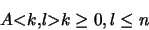
Assume that we want write a static method int sum
takes an argument a of type int[] and returns
the sum of the elements of a. If we
were summing the elements of a list instead of an array,
we could use the natural
recursion scheme on lists to reduce summing a compound list
(a Cons) to summing its tail (the rest component
of the list). We can use exactly the same
scheme to sum an array provided that we use array slices instead
of array values. To process slices, we must write a helper
method sumHelp that takes arguments a and k of
type int[] and int respectively and returns
the sum of the elements in the array slice a<k,n>
where n is the length of the array a. An empty slice
corresponds to the case where  .
A compound
slice corresponds to the case where k < n.
.
A compound
slice corresponds to the case where k < n.
The following Java code implements the sum method
class ArrayUtil {
  public static int sum(int[] a) {
    // returns a[0] + ... + a[a.length-1]
    return sumHelp(a,0);
  }
  public static int sumHelp(int[] a, int k) {
    // given 0 <= k < a.length
    // returns a[k] +  ... +  a[a.length-1]
    if (k >= a.length) then return 0;
    else return	a[k] + sumHelp(a, k+1);
  }
}
From the standpoint of computational resources, neither the natural recursion program nor the equivalent program on array slices given above is efficient because neither one is tail-recursive. A method definition is tail-recursive if recursive calls only appear in ``tail-position'', the last operation before returning from the method. In Scheme, the standard recipe for converting such a computation to tail recursive form involves writing a helper function with an accumulating parameter and summing the elements in the opposite order (left-to-right instead of right-to-left). We can convert our array slice solution to tail-recursive form using essentially the same transformation.
The following Java code implements a tail-recursive solution using array slices:
class ArrayUtil {
  public static int sum(int[] a) {
    return tailSumHelp(a,0,0);
  }
  public static int tailSumHelp(int[] a, int k, int accum) {
    // given 0 <= k < a.length
    // returns accum + a[k] +  ... +  a[a.length-1]
    if (k >= a.length) then return accum;
    else return	tailSumHelp(a, k+1, accum+a[k]);
  }
}
In languages that do not support the efficient translation of tail-recursive procedures to machine code, tail recursive (also called iterative) computations must be expressed in the more restrictive framework of for and while loops to produce efficient code. Some Java Virtual Machines (like the IBM JDK 1.3 JVM) implement tail recursion efficiently; others (notably the Sun JDK JVM's) do not. Hence, to ensure the efficient execution of Java programs performing tail-recursive computations, these computations must be expressed as loops.
A tail-recursive procedure is a more general framework for expressing iterative computations than structured loops! In contrast to structured loops, tail recursive procedures gracefully accommodate multiple exits; each procedure return clause that is not a tail-recursive call is an exit. To translate a tail-recursive programs to loop programs, we must construct loops containing explicit break statements in the general case.
Java has three familiar looping constructs: while loops, do .. while loops, C-style for loops. The first two constructs are completely standard. A while loop has syntax:
while (test) do statementwhere statement is usually a block. A block is simply a sequence of local variable declarations and statements enclosed in braces. The test expression must have boolean type. A do while loop has syntax:
do statement while (test);The only different between the two looping constructs is the obvious one. In a while loop the test is executed before the loop body is executed. In a do while loop the loop body is executed before the em test expression is evaluated. Hence, a do while statement executes the loop body at least once.
The Java for loop is borrowed from C. It has the form
for (init-expr; test; incr-expr) statementwhich simply abbreviates the following code fragment containing a while loop:2.2
init-expr;
while (test) { statement;
incr-expr; }
Let us return to our tail-recursive Java program that sums the elements of an array. Fortunately, we can translate this tail-recursive procedure directly to a simple while loop because it only contains one exit clause. All that we have to do is replace the recursive call by a block of code that (i) updates the procedure parameters to reflect values passed in the tail call2.3 and (ii) jumping back to the beginning of the procedure instead performing the tail call.
class ArrayUtil {
  public static int sum(int[] a) { return tailSumHelp(a,0,0); }
  public static int sumHelp(int[] a, int k, int accum) {
    // pre: given 0 <= k < a.length, k = k', accum = accum'
    // post: returns accum' + a[k'] +  ... +  a[a.length-1]
    while (true) {
      if (k >= a.length) return accum;
      // accum == accum' + a[0] + ... + a[k-1]
      accum = accum + a[k];
      k = k+1;
      // assignment to accum depends on k; k must be modified last
    }
}
class ArrayUtil {
  public static int sum(int[] a)
     returns a[0] + ... + a[a.length-1]
     int accum = 0;
     for (int k = 0; k < a.length; k++) {
      // accum == a[0] + ... + a[k-1]
      accum = accum + a[k];
    }
    return accum;
  }
}
= k+1;The resulting program uses the most attractive idiom in imperative programming: the for loop. This form of processing forms the basis for the most commonly used imperative design pattern: the iterator pattern. We will discuss this pattern in detail in section 2.1.8.
We now turn our attention to more general data representations for sequences that accommodate operations that change the length of sequences.