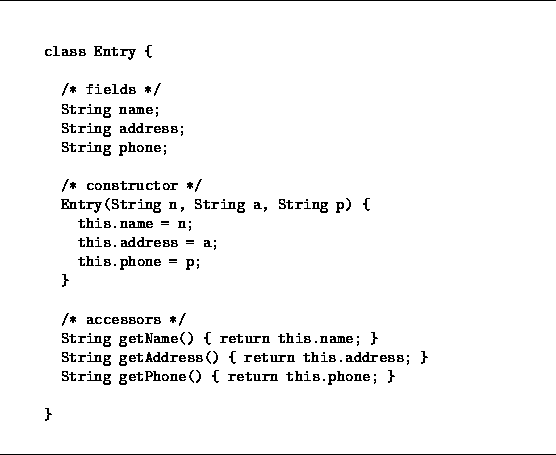
Every Java program consists of a collection of classes--nothing else. A class is a template for creating a particular form of object. A Java class definition corresponds to a Scheme struct definition generalized to include all of the functions and procedures that process objects of the defined class. In Java, all program code is attached to some class.
Each object created by a class template contains the same members, each of which is either a field or a method. A field is a ``container'' that holds a value. A method is an operation on the fields of the object and any values that are passed as arguments to the method. The objects created by a particular class template are called the instances or objects of that class. Each instance contains the members specified by the class template.
Each member of a class has a name consisting of a Java identifier (defined above in Section 1.2.4). For now, we will require that all such names are unique within a class. We will slightly relax this restriction when we discuss overloading in Section 1.11.5.
Java objects are a generalization of Scheme structs. In Java, the collection of operations (methods) that operate an object is determined by the class definition for the object. In Scheme, the set of operations for manipulating a struct is fixed: a constructor, a recognizer, field-accessors, and field-modifiers.
The Java program in Figure 1.1 defines a class Entry
suitable for representing entries in the department directory
application described in Section 1.1.1.
where the name, address and phone fields are always bound to strings.(define-struct Entry (name address phone))
Let's examine the syntax of the Entry class definition. It consists of seven members:
An instance (object) of the class Entry is created by an expression of the form
new Entry("SomeName","SomeAddress","SomePhone")
which creates a Scheme Entry object. The three accessor methods getName, getAddress, and getPhone are equivalent to the Scheme accessors Entry-name, Entry-address and Entry-phone that are automatically generated by the Scheme define-struct definition.(make-Entry "SomeName" "SomeAddress" "SomePhone")
Recall the syntax for method invocation in Java is quite different from the syntax for function application in Scheme. Given an instance e of class Entry, the expression
e.getName()invokes the getName method of object e. The equivalent Scheme expression is written
(Entry-name e)
The three methods defined in class Entry are extremely simple, yet they illustrate the most important characteristic of object-oriented programming: operations are attached to the data objects that they process. The methods getName, getAddress, and getPhone take no arguments yet they have access to the fields of the Entry object to which they are attached. The Entry object e in the method call
e.getName()is called the receiver because it ``receives'' the method call.1.2
In the code for the Entry class, the constructor and accessor methods all refer to fields of this, the hidden parameter bound to the object that is the receiver of the method invocation. For example, the expression
this.namereturns the value of the name field of the object this. In constructor invocations, this is bound to the newly allocated object.
One attractive feature of Java is that the method syntax mandates a contract (declaration of input types and output type) as part of the method header. For example, the method header
indicates that the getName method takes no arguments (other than the ``receiver'' as an implicit argument this and returns a String value. In subsequent examples, we will define methods that take explicit arguments; the type of each such argument must be declared in the method header.String getName()
Finger Exercise: In the Definitions window of DrJava,
enter the Java program defining the Entry
class given earlier in this section.
In the DrJava Interactions window, try
evaluating the following program text:
Entry e =  new Entry("Corky", "DH 3104", "x 6042");
e.getName()
e.getAddress()
e.getPhone()
We will explain the syntax of Java class definitions in more detail in Section 1.4.